What Are AI Agents? (And Why They're Not Just ChatGPT's Overachieving Cousin)

Estimated read time: 8 minutes

You've been chatting with ChatGPT, asking it questions, getting decent answers, feeling quite pleased with yourself for being so tech-savvy. Then someone at the pub mentions "AI agents" and you nod knowingly while internally panicking because you haven't got a clue what they're on about.

Here's what you're probably thinking: "Isn't that just... AI? Like, what I've already been using? Are they just making up new terms to sound clever?"

Fair questions. But here's the thing - AI agents are genuinely different. It's like the difference between someone who can tell you how to bake a cake (regular AI) versus someone who actually goes into your kitchen, measures the ingredients, preheats the oven, and delivers you a finished Victoria sponge whilst you're watching Netflix (AI agent).

Cartoon-style image of a glorious Victoria sponge cake on a kitchen counter, symbolising an AI agent that not only gives instructions but actually does the work — representing hands-on AI collaboration and automation.

Here's what nobody tells you: Most people using "AI" are still doing 90% of the work themselves. They ask ChatGPT for an answer, then manually copy it, format it, send it, update their spreadsheet, schedule the follow-up, and wonder why they're exhausted. AI agents do all of that. You give them the goal, they sort the rest.

The numbers that matter: Research on early AI agent implementations shows 7.8% productivity increases and 30% reductions in time spent on repetitive tasks.

What you'll discover:

  • The actual difference between AI and AI agents (without the tech waffle)

  • Why AI agents are changing how businesses work (with real examples that'll make sense)

  • Which tasks you should hand over to AI agents right now

  • How to start using them without needing a computer science degree

🤖 New to AI completely? Get our Free Beginner's AI Cheat Sheet first - covers the basics before we dive into the clever stuff.

🧩 The Honest Truth: What Actually IS an AI Agent?

Right, let's clear this up properly.

Regular AI (like ChatGPT):

Ask it a question → Get an answer → Copy that answer → Do something with it yourself → Repeat

You're basically having a very clever conversation with a very knowledgeable mate who can't actually do anything for you.

AI Agents:

Give it a goal → It makes a plan → Uses whatever tools it needs → Actually completes the task → Reports back when done

The agent doesn't just tell you what to do - it actually does it.

AI agent organizing chaotic business tasks into automated workflows

☕ The Coffee Shop Analogy (Because Everyone Loves Coffee)

Regular AI is like asking a barista: "How do I make a flat white?"


They'll explain the process brilliantly. You'll nod along. Then you still have to make the coffee yourself.

AI Agent is like having an actual barista who:

  • Checks if you have coffee beans (perception)

  • Grinds them to the right consistency (planning)

  • Steams the milk to 65°C (action)

  • Delivers you a perfect flat white (completion)

  • Remembers you take it extra hot next time (learning)

Whimsical cartoon robot multitasking as a barista, showing how AI agents plan, act, and complete tasks automatically.

All whilst you're scrolling through your phone ignoring them entirely.

🧠 AI agents can collaborate with each other. Some systems let multiple agents communicate and divide tasks — like one researching data while another writes summaries... forming a mini digital team that self-organises.

⚙️ What Makes AI Agents Actually Different

According to IBM's research, AI agents are systems capable of autonomously performing tasks by designing their workflow and utilising available tools. Let's translate that from corporate speak into English:

They can perceive their environment: An AI agent understands where it is and what's available - whether that's your email inbox, calendar, spreadsheets, or customer database.

They have actual tools: They can use your calendar app, send emails, update spreadsheets, book appointments, search the web, analyse data - whatever's needed to complete the task.

They make decisions: When something unexpected happens, they figure out a different approach rather than just stopping and bothering you.

They remember things: Unlike regular AI that forgets your entire conversation the moment you close the tab, agents remember context across multiple interactions.

They work autonomously: Once you set them going, they crack on without needing constant supervision. Like a brilliant intern who actually knows what they're doing.

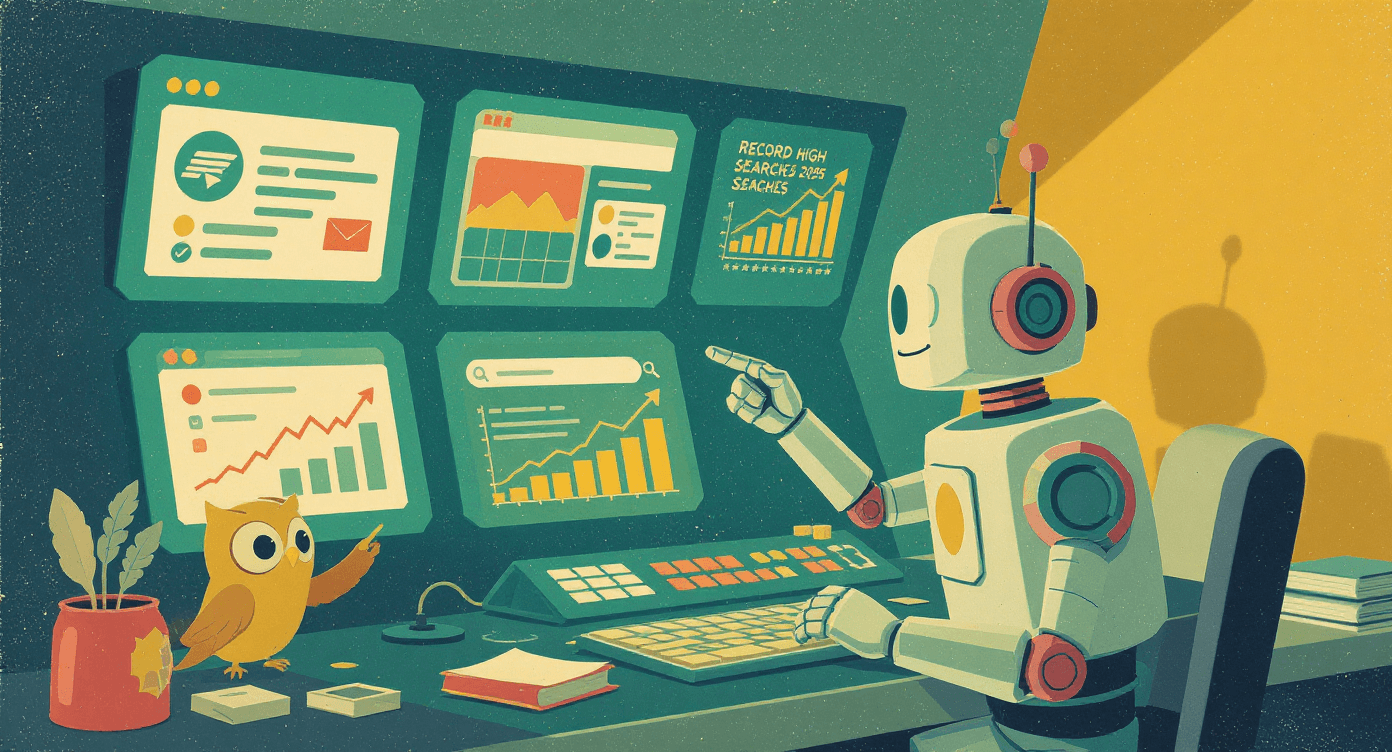
Recent data shows that searches for "AI agents" hit record highs in 2025, which means everyone's suddenly cottoned on to how useful these things actually are.

Cartoon robot monitoring glowing screens and data graphs showing record 2025 interest in AI agents, representing their growing usefulness.

💡 Why Should You Actually Care?

Because you're probably doing things manually that an AI agent could handle whilst you sleep.

💍 The Manchester E-commerce Owner

Jenny runs an online jewellery shop. She used to spend two hours every morning:

  • Checking customer emails

  • Updating inventory spreadsheets

  • Replying to basic questions ("When will my order arrive?" × 35)

  • Scheduling social media posts

  • Monitoring competitor prices

Cartoon scene of jewellery maker working creatively while AI agent manages online shop tasks in background, showing collaboration between humans and AI.

Then she set up an AI agent using CustomGPT.ai. Here's why she picked it: you can build custom agents without coding... just upload your FAQs, product details, and policies. No monthly retainer for a developer.

Her AI agent now:

  • Answers routine customer questions (the "where's my order" variety)

  • Updates inventory when stock levels change

  • Drafts responses for complex queries (she reviews before sending)

  • Monitors competitor pricing and flags significant changes

Time saved: 10 hours weekly


Jenny's honest take: "I spend about 30 minutes daily checking what the agent did. But that beats two hours of 'when will my order arrive' emails. Plus I actually design jewellery now instead of just selling it."

The reality: CustomGPT.ai integrates with tools like Shopify and Gmail, but setup took her a full afternoon and a few YouTube tutorials. Free trial lets you test before committing—wise move given everyone's workflow is different.

Close-up of elegant jewellery arranged neatly in a jewellery box, symbolising creativity, craftsmanship, and organised small business presentation.

🧑‍💻 The Freelance Consultant Reality Check

James does IT consulting for small businesses. His biggest time drain? Research.

Every client project required:

  • Gathering information from 15+ sources

  • Cross-referencing technical specifications

  • Staying current with industry changes

  • Synthesising everything into coherent recommendations

Cartoon owl consultant analysing holographic data with a robot assistant, showing how AI agents help freelancers research faster and smarter.

He started using Perplexity Pro with its AI agent capabilities (not just search - actual research agents that can follow threads, verify sources, and build comprehensive reports).

His AI research agent:

  • Monitors relevant industry news automatically

  • Researches technical solutions across multiple sources

  • Fact-checks information against credible databases

  • Creates structured reports (though he still edits them)

  • Suggests related areas worth investigating

Result: Client deliverables that used to take 6 hours now take 90 minutes of agent research + 45 minutes of his strategic analysis.

James's reality check: "First week I spent more time fixing the agent's mistakes than doing research myself. Week two it clicked. Now I fact-check its work but rarely find errors. It's like having a research assistant who never gets tired but occasionally needs adult supervision."

The cost equation: Perplexity Pro costs £20/month. James bills at £150/hour. Saving 3.5 hours per client project means the tool pays for itself after one project. Everything after that is pure profit.

Laptop on a table displaying Perplexity AI, symbolising research automation and intelligent information gathering for freelancers.

⏰ The Moment You Actually Get It

Here's when most people properly understand AI agents:

You're at your desk at 6:30 PM on a Thursday. You've spent the day on actual client work, strategy, creative thinking, relationship building. The stuff you're good at.

Then you check your task list and realise all the tedious bollocks that usually keeps you there until 9 PM is... done.

Customer emails answered. Data entry completed. Social posts scheduled. Research compiled. Invoices processed.

You close your laptop and go home for dinner. On a Thursday. At 6:30 PM.

That's not "improved productivity." That's getting your life back.

Two cartoon cats presenting slides to an audience — illustrating how teams use AI presentation tools like Gamma for better collaboration.

This isn't about efficiency for efficiency's sake.

It's about spending your time on work that requires your brain, not your ability to copy-paste between systems like some sort of very expensive data entry clerk.

Right, now let's get specific about how AI agents actually differ from regular AI...

🧠 They can develop “memory loops.” Advanced agents store context from previous actions, meaning they can recall past decisions, adapt strategies, and even learn from their own mistakes over time... a quiet step toward true continuous learning.

⚖️ AI Agents vs Regular AI: The Actual Difference

Let's make this crystal clear with real examples:

✈ Scenario 1: Planning a Business Trip

ChatGPT conversation:

You: "I need to travel to Edinburgh for a client meeting next month"


ChatGPT: "I can help you plan that trip! You'll need to book flights, find accommodation, arrange transport..."


You: "Right, cheers. So now I'll spend an hour doing all of that myself"

AI Agent workflow:

You: "I need to travel to Edinburgh for a client meeting next month"


Agent:

  • Checks your calendar for available dates

  • Searches flights within your budget

  • Books hotel near the meeting location

  • Adds everything to your calendar

  • Sends confirmation to your email

  • Sets reminders for check-in

  • Adds the client meeting location to your GPS Then reports back: "Edinburgh trip sorted. Flight departs 8:40 AM, hotel checkout is 11 AM day after meeting. Total cost £340."

See the difference? One gives advice. The other actually sorts your life out.

Cartoon robot travel agent planning a client’s business trip with digital tools, representing AI agents autonomously managing travel logistics.

📦 Scenario 2: Customer Service Nightmare

Customer: "My order hasn't arrived and I need it urgently"


Chatbot: "I understand your concern. Please contact our support team at support@company.com or call 0800-HELP for assistance with order tracking"


Customer: Leaves frustrated 1-star review

AI Agent approach:

Customer: "My order hasn't arrived and I need it urgently"


Agent:

  • Looks up order number from customer account

  • Checks tracking information across carrier systems

  • Identifies delay at distribution centre

  • Determines delivery will be 3 days late

  • Offers two options: refund now or 20% off next order plus priority shipping Responds: "Found your order—stuck at the depot since Tuesday. I can either refund you now, or get a replacement shipped priority (arrives tomorrow by 2 PM) plus 20% off your next purchase.

    Which works better?"

Creative design process - cartoon artist creating professional quality content with design tools

The catch: You'll still need to review edge cases... the agent once offered a refund on an item that was literally out for delivery. But for 90% of queries? Handles them better than your best customer service person on their best day.

Research from Salesforce shows that AI agents can reason and ground answers in relevant knowledge, whilst chatbots largely follow rules-based dialogues limited to predefined questions.

Translation? Agents actually solve problems. Chatbots just... chat.

🧰 What Can AI Agents

Actually Do?

(Real Business Examples)

Let's stop being theoretical and get specific. Here are five tasks you're probably doing manually right now that AI agents can handle whilst you do literally anything else:

Cartoon AI robot juggling icons for multiple business functions, illustrating AI agents multitasking across content, data, and customer management.

📧 1. Email Management (Without the Existential Dread)

The problem: 127 unread emails. Most are rubbish, some are urgent, all demand your attention.

What AI agents handle:

  • Sort emails by priority (urgent client vs newsletter spam)

  • Draft replies to routine questions

  • Schedule meetings mentioned in emails

  • Flag important messages for your attention

  • Archive or delete obvious junk

  • Follow up on emails that need responses

Platform that does this: Assista

- an AI agent specifically built for email and calendar management. It learns your communication style, understands your priorities, and handles the tedious stuff whilst flagging anything that genuinely needs your brain.

Assista works across Gmail, Outlook, and other major platforms. It's like having an EA who actually reads your mind about what's important and what's just noise.

Assista offers a free tier to test whether their AI agent understands your workflow before upgrading.

Cartoon robot surfing a wave of emails into order, representing AI agents turning inbox chaos into calm productivity.

📝 2. Content Creation (That Doesn't Sound Like a Robot Wrote It)

Cartoon robot artist crafting colourful content on a digital canvas, representing AI agents generating creative, brand-friendly material.

The problem: You need blog posts, social media content, product descriptions, and email campaigns. Also, you need to eat and sleep occasionally.

What AI agents handle:

  • Research topics and current trends

  • Write content in your brand voice

  • Optimise for SEO without making it unreadable

  • Create multiple versions for different platforms

  • Schedule publishing across channels

  • Monitor performance and suggest improvements

For content creation workflows, platforms like Systeme.io combine AI agents with marketing automation - meaning your agent doesn't just write content, it publishes, tracks performance, and optimises future content based on what actually works.

📊 3. Data Analysis (Without the Spreadsheet-Induced Panic Attacks)

The problem: Sales data, customer feedback, website analytics, inventory numbers - somewhere in this mess is information you need to make decisions.

What AI agents handle:

  • Pull data from multiple sources (Shopify, Google Analytics, CRM, etc.)

  • Identify trends humans would miss

  • Create visualisations that actually make sense

  • Generate reports explaining what's happening and why

  • Suggest actions based on the data

  • Monitor metrics and alert you to significant changes

Cartoon robot turning messy data into clear charts, illustrating how AI agents simplify data analysis and reporting.

📣 4. Social Media Management (Without Losing Your Sanity)

The problem: You know you should be posting consistently across platforms. You also know you should be sleeping, eating, and occasionally running your actual business.

Real scenario: It's Tuesday. You haven't posted on Instagram since Friday. LinkedIn is tumbleweeds. Someone left a comment on Facebook three days ago that you just noticed. Your content calendar is a lie you tell yourself. Meanwhile, your competitors are posting daily and you're convinced they've either cloned themselves or never sleep.

What AI agents actually handle:

Content that doesn't sound like a robot wrote it:

  • Monitors what's performing well in your industry right now

  • Suggests post ideas based on your business and trending topics

  • Creates variations for different platforms (professional for LinkedIn, casual for Instagram)

  • Schedules everything for optimal posting times (not 3 AM when you finally remember)

Cartoon robot managing social media posts and engagement, representing AI agents scheduling and responding across platforms efficiently.

Engagement without the existential dread:

  • Watches for brand mentions across platforms

  • Responds to routine comments ("Great post!" gets "Thanks for reading!")

  • Flags important conversations needing your actual brain ("Your product broke" = human intervention required)

  • Tracks which types of posts get engagement vs. which die quietly

The bit that saves your reputation:

  • Spots negative sentiment before it becomes a crisis

  • Alerts you when someone with 50K followers mentions you

  • Identifies your most engaged followers (the ones actually worth building relationships with)

  • Tells you which content types work and which are wasting your time

Real example: Marketing consultant Rachel used to spend Sunday afternoons batch-creating social content whilst resenting every minute.

Now her AI agent monitors industry news, suggests three post ideas daily based on what's trending, and schedules them across platforms. She spends 20 minutes reviewing and tweaking instead of 3 hours creating from scratch.

Her honest take: "The AI-generated posts aren't Shakespeare, but they're 80% there. I edit for personality, hit approve, and actually have Sunday afternoons back. Plus engagement is up because we're posting consistently instead of whenever I remember."

Cartoon of Shakespeare reacting to a robot editing his writing, humorously showing AI improving even the Bard’s over-complicated drafts.

📂 5. Administrative Tasks (The Soul-Destroying Stuff)

The problem: Data entry, invoice processing, appointment scheduling, expense tracking - necessary but utterly mind-numbing.

What AI agents handle:

  • Process invoices and match them to purchase orders

  • Update CRM with customer information

  • Schedule meetings considering everyone's availability

  • Track expenses and categorise them properly

  • Generate reports summarising all this tedious admin

  • Actually send reminders so things get done

🦝 Curious about the technology that makes all this possible? Our guide on What is AI explains the fundamentals without the technical jargon.

🐘The Elephant in the Room: Will AI Agents Take My Job?

Short answer: No, but they'll definitely change how you work.

The honest reality:

AI agents aren't replacing people - they're replacing the tedious bits of jobs that make people question their life choices at 4 PM on a Wednesday.

What's actually happening in 2025: According to IBM and Morning Consult research, over 95% of developers are actively building or experimenting with AI agents.

The AI agent market is projected to grow from $5.1 billion in 2024 to $47.1 billion by 2030. According to MarketsandMarkets research, this explosive growth is driven by businesses augmenting human capabilities rather than replacing workers.

What AI agents are brilliant at:

  • Repetitive tasks that follow patterns

  • Processing large amounts of information quickly

  • Working 24/7 without coffee breaks or existential crises

  • Following rules consistently without getting bored

  • Never taking a sickie because they had "a dodgy prawn"

Cartoon of robot and human tending a shared garden, representing humans and AI agents working side by side for productivity and growth.

What AI agents are rubbish at:

  • Creative problem-solving that requires genuine innovation

  • Understanding nuanced human emotions and context

  • Making strategic decisions that need business intuition

  • Building relationships based on empathy and trust

  • Knowing when to break the rules because the situation demands it

IBM researchers note that whilst AI agents can plan, reason, and use tools to perform tasks at speed and scale, humans are still required for complex decision-making and oversight.

Real example: That freelance consultant James? He's not redundant because his AI research agent exists. He's more valuable because he can now handle three times as many clients, spend his time on actual strategy rather than data gathering, and deliver better results faster.

His AI agent handles the grunt work. He handles the thinking, relationship-building, and strategic recommendations that require human judgement.

Cartoon robot shielding people from rain while they talk, representing AI tools supporting the relationships that humans build.

🚀 How to Actually Start Using AI Agents (Without a PhD)

🎯 Step 1: Identify One Tedious Task (Just One)

Don't try to automate your entire business on Tuesday afternoon. Pick the single most soul-destroying task that's:

  • Repetitive and follows a pattern

  • Takes significant time each week

  • Doesn't require creative human judgement

  • Makes you question why you started a business

Examples:

  • Responding to routine customer inquiries

  • Scheduling social media posts

  • Updating spreadsheets from multiple sources

  • Processing standard emails

Cartoon rat with oversized to-do list while AI robot narrows it to one simple action, illustrating the first step in adopting AI agents.

🔨 Step 2: Choose the Right Tool for That Specific Job

Different AI agents specialise in different things. Don't buy a Formula 1 car for the school run.

For customer service: CustomGPT.ai - Build a custom agent trained on your business

For research and information: Perplexity Pro - Research agents that actually investigate

For email management: Assista - Specifically designed for inbox sanity

For marketing automation: Systeme.io - Content plus distribution plus tracking

Cartoon meerkat choosing the right AI tool from a shelf with help from a robot, symbolising picking the best tool for each task.

📚 Want the complete toolkit? Our 7 Beginner-Friendly AI Tools guide covers versatile options that work across different business needs.

🧪 Step 3: Test It For Two Weeks

Week 1:
Set up the AI agent with your specific information, test it on small tasks, watch it like a hawk, correct its mistakes.

Week 2:
Give it slightly more responsibility, monitor the results, adjust settings based on what you've learned.

Success metric: If you've saved at least 2 hours without creating new problems, it's working.

Cartoon dog testing an AI agent’s performance in a safe environment, symbolising trial and observation during early automation setup.

📈 Step 4: Scale Gradually (Don't Go Mental)

Once one agent works reliably, add another for a different task. Build your AI workforce slowly rather than trying to automate everything simultaneously and creating chaos.

The progression that actually works:

  • One agent handling one specific task

  • Agent expands to handle variations of that task

  • Add second agent for completely different task

  • Connect agents to work together on complex workflows

  • Actually have time to grow your business instead of drowning in admin

Cartoon raccoon and robot driving up a milestone hill, illustrating the process of scaling AI agents carefully and intentionally.

⚠️ The Mistakes Everyone Makes

(Learn From Others' Pain)

Trying to Automate Everything Immediately

You'll create more problems than you solve. Start with one task, master it, then expand.

Not Training the Agent Properly

AI agents need information about your business, processes, and preferences. Garbage in, garbage out still applies.

Forgetting to Monitor Results

Set it and forget it works for slow cookers, not AI agents. Check their work regularly, especially initially.

Expecting Perfect Results Day One

AI agents learn and improve with feedback. They're not plug-and-play perfection from minute one.

Choosing Complex Tools When Simple Ones Would Work

Don't buy enterprise software when a straightforward solution handles your actual needs.

📎 For a complete list of AI implementation pitfalls and how to avoid them, check out our guide on 5 Common AI Mistakes Beginners Make.

🗓️ Your "Start Small" Action Plan

📅 Week 1: Pick One Task

Time investment: 2 hours
Choose one task from this list:

  • Customer service FAQs

  • Email management

  • Social media scheduling

  • Research and data gathering

  • Administrative data entry

Action: Write down exactly what this task involves and how long it currently takes you weekly.

Cartoon wolf business owner planning a weekly schedule, symbolising structured AI-assisted productivity.

🔨 Week 2: Test One Tool

Time investment: 3 hours


Action: Sign up for free trial of the most relevant tool for your chosen task. Most platforms offer 7-14 day trials with no commitment.

Test checklist

  • Can it actually do what you need? (Be honest)

  • Does it integrate with tools you already use?

  • Is it intuitive enough that you'll actually use it?

  • What's the time saving vs. learning curve?

📐Week 3: Measure and Decide

Time investment: 1 hour


Questions to answer:

  • Did it save time or create more work?

  • Is the quality acceptable for your standards?

  • Would you pay for this after the trial ends?

  • What would need to change to make it worth keeping?

Decision: Keep and expand, or try a different approach.

Need help actually getting better results from AI? Our Prompt Like a Pro digital guide gives you simple frameworks and ready-to-use templates that teach you how to write prompts that actually work... no jargon, no guesswork, just practical steps for clearer, more consistent AI results.

🔚 The Bottom Line:

AI Agents Are Here

(So You Might As Well Use Them)

Here's what's actually happening: businesses that adopt AI agents are quietly getting more done with less stress whilst their competitors are still manually copying data between spreadsheets at 9 PM.

The competitive reality nobody mentions: Your competitors are reading this too. Some will implement AI agents next month. Others will wait until they're "ready" (they never are) or until it's "proven" (it already is).

By the time the cautious ones decide to start, the early adopters will be handling 3x the workload with the same team size, responding to customers in minutes instead of hours, and actually leaving the office before dinner time.

The early adopters aren't tech geniuses - they're practical business owners who realised AI agents could handle the tedious stuff whilst they focus on the interesting work that requires actual human intelligence.

AI agents won't replace you - but someone using AI agents probably will if you're still doing everything manually. That's not a threat, it's just maths. They'll serve more customers, respond faster, deliver better quality, and still have energy left for strategy and growth.

Cartoon robot helping a small business owner save money through efficient automation, representing AI as an affordable investment.

The technology is ready, accessible, and affordable right now. Not "coming soon." Not "in beta." Actually available today, often with free trials or affordable monthly subscriptions that cost less than your coffee habit.

Start with one small task. Choose a straightforward tool. Test it for two weeks.

You might discover you actually enjoy running your business again when you're not drowning in administrative bollocks that a machine can handle perfectly well.

The future of work isn't about choosing between humans OR AI agents. It's about humans AND AI agents working together - with each doing what they're actually good at.

You handle the thinking, the relationships, the creativity, the judgement calls. The AI agent handles the data entry, the scheduling, the routine emails, the repetitive research.

One of you should be working at 3 AM. It shouldn't be you.

Welcome to working smarter instead of just working harder.

Cartoon business owner and AI robot finishing work early together, symbolising how automation gives time back to people.

Simplify AI

Making AI make sense -- one prompt at a time

Declaration

Some links on this site are affiliate links.

I may earn a small commission, but it doesn't

cost you anything extra.

I only recommend tools i trust

Thank you for your support

Socials

Email : no-jargon-ai@outlook.com

Tiktok : @no-jargon-ai

Instagram : @no-jargon-ai

Location

Based in Mansfield, Nottinghamshire

Simplifying AI for beginners, no matter

where you're starting from.

All Rights Reserved.